The 20-Fold Gap in Genetics and Muscle Growth
I have small wrists. Small ankles. A bone frame that limits how much muscle I can carry before I start looking like I borrowed someone else's body. By most of the metrics I am about to list, my genetics for building muscle sit somewhere around average. Maybe slightly below, depending on the body part.
I still built a physique I am genuinely proud of. Took longer than it would have taken someone with thicker bones and better muscle insertions. But it happened. And that is the thing nobody tells you when they talk about genetics. Knowing your limitations does not mean accepting them. It means you stop wondering why you do not look like the guy next to you after six months and start focusing on your own trajectory.
This piece is about the physical hand you were dealt: the frame, the insertions, the leverages. For the quantified side, how much of muscle growth is actually heritable and how much of the range is yours to move, start with what the genetics and muscle growth research actually quantifies.
The Actual Numbers on Individual Variation
Forget the vague "everyone responds differently" advice. Hubal and colleagues put 585 people (342 women, 243 men) through the exact same 12-week progressive resistance training program across 8 study centers. The results, published in Medicine and Science in Sports and Exercise (2005), showed muscle cross-sectional area changes ranging from -2% to +59%.
That is a roughly 20-fold difference in hypertrophic response to identical training. Some participants showed virtually no muscle growth. Others showed profound increases. Same exercises, same progressive overload, same duration. The only variable was the person.
Men experienced 2.5% greater gains for cross-sectional area compared with women. But notice how small that sex difference is compared to the massive individual variation. Your genetics matter more than your sex for determining how much muscle you will build.
Up to 70% Is Hereditary, But That Leaves a Lot of Room
Roberts and colleagues published a comprehensive review in Frontiers in Physiology (2018) examining the physiological differences between high and low hypertrophic responders. Their synthesis of twin studies and heritability research estimated that up to 70% of the observed variability in muscle strength and size in young adults is attributable to hereditary factors.
70% sounds deterministic. It is not.
That figure is an upper estimate from twin studies, and it may overstate genetic determinism in practical contexts. The review found that high responders show higher intramuscular androgen receptor protein content and greater satellite cell activity following training. But critically, individual gene candidates share only marginal variance with hypertrophic outcomes. The genetics of muscle growth are polygenic, meaning hundreds of genes contribute small effects. No single gene makes or breaks your potential.
And the 30% that is not genetic? That is training program quality, protein intake, sleep, stress management, and consistency over years. For most people, this 30% is nowhere near maximized.
The ACSM 2026 Position Stand Changes the Conversation
The American College of Sports Medicine released their first resistance training position stand update in 17 years in 2026. It synthesized 137 systematic reviews covering over 30,000 participants. The largest evidence synthesis on resistance training ever conducted.
Two findings are directly relevant to the genetics question.
First: equipment type (machines, free weights, bands, bodyweight) does not consistently impact outcomes when effort and volume are matched. This matters because it means your response to training is driven by the signal you send (volume and effort), not by the tool you use to send it. Genetics may determine how strongly your body responds to that signal, but the signal itself is completely within your control.
Second: the dose-response relationship for hypertrophy (10-20 sets per muscle group per week) is highly individual. Some people need to be at the top of that range to see meaningful gains. Others respond well at the lower end. The minimum effective dose for muscle growth is as low as 4 sets per muscle group per week.
This is the practical bridge between genetics and action. If you are a lower responder, you may need more volume. The ACSM data says that adjusting volume upward can partially compensate for lower genetic responsiveness. You are not stuck with whatever your first response was.
The Problem With "Bad Genetics"
Around 40 to 60 percent of your muscle-building potential is genetically predetermined. That is from twin studies and heritability research. Solid data. Real number.
But most people use that information as an excuse. Cannot lose weight? Hormones. Not gaining muscle? Genetics. It becomes this convenient story that lets you stop looking at the stuff you are actually doing wrong. The inconsistent training. The 70 grams of protein per day. The five hours of sleep. Most of these people have never tracked their training volume properly either.
And the thing is, you are almost certainly average. The Hubal study shows up to a 20-fold difference between the best and worst responders. But that is a bell curve. Most people are bunched in the middle. You are probably not a genetic freak in either direction.
DNA Testing? Save Your Money
I get asked about this constantly. Should I do a DNA test to find out my muscle-building potential?
No. A commercial DNA test looks at maybe 20 genes. You have over 20,000. And it is not even the individual genes that matter. It is how they interact with each other, with your enzymes, with your environment, with a hundred other things we do not fully understand yet. The Roberts review confirmed this: single gene candidates share only marginal variance with hypertrophic outcomes.
Professional sports teams with billion-dollar budgets are not using DNA tests for talent identification. If they cannot make it useful, a $200 consumer report telling you to "eat more protein and train harder" is not going to change your life.
Testosterone Indicators (Male)
This is a rough one, not a blood test. But the secondary sex characteristics that show up during puberty can give you a general idea of where your testosterone sits.
Things that tend to correlate with higher levels:
- A lot of body hair (face, forearms, chest, stomach)
- Balding. Yeah. DHT, which is a testosterone derivative, is what causes the hair on top of your head to thin. So that receding hairline might actually be a good sign for the gym
- Deeper voice
- Wider, more angular jaw
None of this is precise. I have coached hairy guys with deep voices who had completely average testosterone when they actually tested it. But as a cluster of signs, it points in a direction.
Bone Frame
This is the one that matters most and gets talked about least.
Your skeleton is the frame. The frame determines how much muscle it can hold. Thicker bones, more muscle capacity. Olympic weightlifters? Thick wrists, thick ankles. Not a coincidence. It is one of the strongest predictors of success in strength sports.
Most people have a mix. Maybe your wrists are small but your shoulders are wide. That is normal. Nobody is perfectly built or perfectly limited.
- Wrist circumference >7.5 inches (male)
- Thicker ankles and joints
- Higher absolute muscle potential
- Better suited for strength sports
- Wrist circumference <6.5 inches (male)
- Narrower joints
- Lower absolute ceiling but still substantial
- Can build impressive relative physique
Want to check yours? Wrap a tape measure around your wrist right below the bone. Men: under 6.5 inches is small frame, 6.5 to 7.5 is medium, over 7.5 is large. Women, subtract about an inch from each.
The 2D:4D Finger Ratio
This sounds ridiculous. I know. But the research is actually decent.
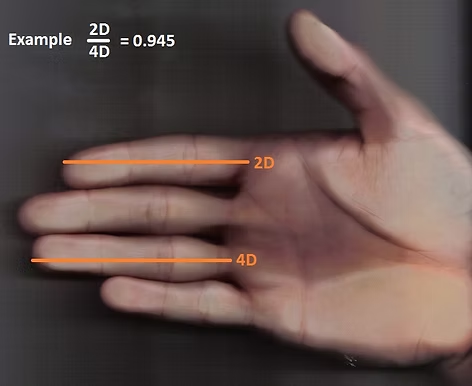
Look at your right hand. Measure the length of your index finger and your ring finger, from the crease at the base to the tip. Divide index by ring. If your ring finger is noticeably longer than your index finger (ratio below about 0.95), that is associated with higher prenatal testosterone exposure. Several studies have linked this to better athletic performance.
Is it going to change how you train? No. But it is interesting. And it is a better indicator than whatever that DNA test was going to tell you.
Muscle Insertions
This is the one that drives bodybuilders crazy, because you genuinely cannot do anything about it.
Where your tendons attach to the bone determines the length of the actual muscle belly. Longer belly means more room for the muscle to grow. Shorter belly means it peaks more but has less total surface area.
Two examples that make this obvious:
Back. Some people have lats that insert low on the torso. They get that wide, thick look. Others have high insertions and there is a visible gap at the bottom. Same exercises, same years of training. Completely different result. Genetics.
Biceps. Flex your arm at 90 degrees. How many fingers can you fit between your bicep and the inside of your elbow? One finger or none? Long insertions, more growth potential. Two or three fingers? Shorter insertions. You will still build decent arms. They will just look different.
I have short bicep insertions. It used to bother me. Then I realized I had spent more time measuring the gap than actually training, and moved on.
Leverages
Different body proportions completely change how compound lifts work. Short torso, long femurs? You will naturally squat with more forward lean. Long torso, shorter legs? More upright. Both are correct. Both build muscle. They just look nothing alike.
I have had clients hurt themselves trying to copy a squat technique from Instagram without realizing the person in the video has completely different limb lengths. Do not do this. A good squat form is a range that depends on your body. Not a single position copied from someone else.
What I Actually See With Clients
I have coached hundreds of people at this point. The variation is real. Some people show visible change in eight weeks. Others grind for six months before anything moves. Same effort, same adherence. Different bodies.
The slow responders almost always have something else going on. Sleep is a mess. Protein is way too low. Program is not structured for progressive overload. Stress is destroying their recovery. If body composition is the sticking point rather than raw muscle gain, resistance training beats cardio for fat loss regardless of your genetic starting point.
I have watched clients with average frames and nothing special hormonally outperform clients who looked like they were built for this sport. Showed up every session. Hit their protein. Slept. It is not complicated. It is just boring, and boring does not sell on social media.
The real question is not "do I have good genetics." It is "have I actually maxed out the stuff I can control." And in my experience, the answer is almost always no. The ACSM 2026 guidelines confirm this at the population level: adjustable training variables explain a massive share of the outcome.
My Transformation
I mentioned the small wrists. Small-to-medium frame by the measurements in this article. Not built for maximum mass.
But compare a photo of me at 18 to now and it is a different person. Not because of some mindset hack. Because I showed up for years. Structured program. Enough protein. Tracked progression. Slept.
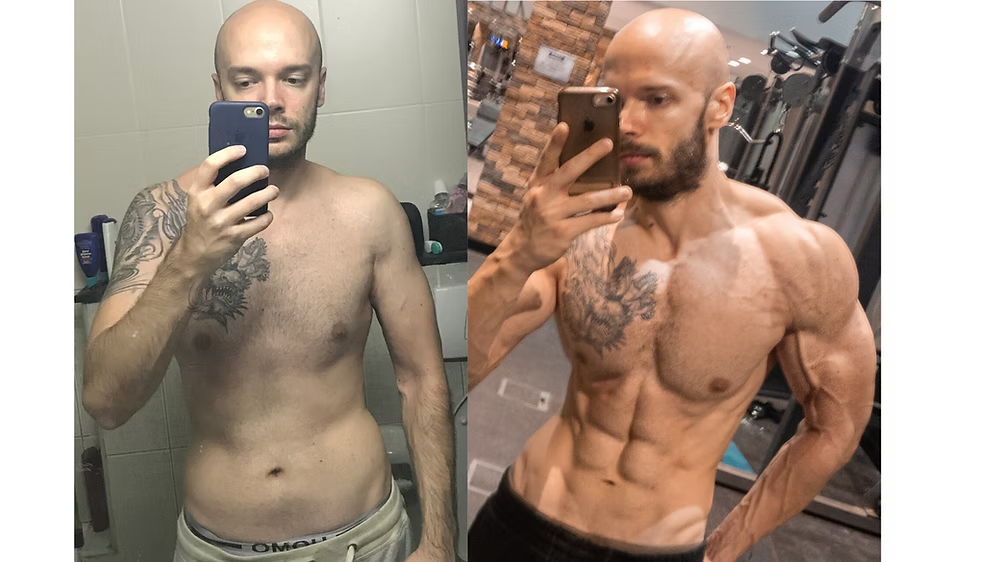
My ceiling is lower than some people's. Fine. I am nowhere near it yet. And neither are you, probably.
So before you decide genetics are the problem, answer these honestly:
- Is your training program actually structured with progressive overload?
- Are you hitting at least 1.6g of protein per kilogram?
- Are you sleeping 7 hours? Consistently?
- Training 3+ days per week, every week, not just when you feel like it?
- Are you tracking lifts so you know whether you are progressing or just exercising?
If any of those are a no, genetics are not your bottleneck. Your program is.
Frequently Asked Questions
Are my genetics bad for muscle growth?
Probably not. The Hubal study showed most people cluster near the middle of the response curve, not at the extremes. A -2% to +59% range sounds alarming, but the majority of 585 participants fell in a moderate range. True "non-responders" are rare, and even the lowest responders gained some muscle.
How much muscle can I build with average genetics?
More than you think. The ACSM 2026 position stand found that hypertrophy occurs across a wide range of conditions when volume is sufficient. Even at the minimum effective dose of 4 sets per muscle group per week, measurable gains occur. For most people with average genetics training consistently at 10-20 sets per muscle group per week with adequate protein, a noticeable physique transformation over 1-3 years is realistic.
About Be Fit and Strong Evidence-based fitness coaching for busy professionals in Dubai. Built by Mirza.
And if you want someone to look at the whole picture and figure out where the gaps actually are, that is literally what coaching is for.
- 1Hubal MJ, Gordish-Dressman H, Thompson PD, Price TB, Hoffman EP, Angelopoulos TJ, Gordon PM, Moyna NM, Pescatello LS, Visich PS, Zoeller RF, Seip RL, Clarkson PM (2005). Variability in muscle size and strength gain after unilateral resistance trainingMedicine & Science in Sports & Exercise
- 2Roberts MD, Haun CT, Mobley CB, Mumford PW, Romero MA, Roberson PA, Vann CG, McCarthy JJ (2018). Physiological Differences Between Low Versus High Skeletal Muscle Hypertrophic Responders to Resistance Exercise Training: Current Perspectives and Future Research DirectionsFrontiers in Physiology
- 3Currier BS, D'Souza AC, Fiatarone Singh MA, Lowisz CV, Rawson ES, Schoenfeld BJ, et al. (2026). Resistance Training Prescription for Muscle Function, Hypertrophy, and Physical Performance in Healthy Adults: An Overview of Reviews (ACSM 2026 Position Stand)Medicine & Science in Sports & Exercise