The New ACSM Resistance Training Guidelines Favor Simplicity
The New ACSM Resistance Training Guidelines Favor Simplicity
The Short Answer
The ACSM just released their first resistance training position stand in 17 years. They synthesized 137 systematic reviews covering 30,000+ participants. The biggest takeaway for busy professionals: you do not need to train to failure, you do not need heavy weights for muscle growth, and consistency beats program complexity every time.
137 Reviews, One Clear Message: Keep It Simple
The American College of Sports Medicine published their updated resistance training position stand in Medicine & Science in Sports & Exercise (Currier et al., 2026). This is not a single study. It is an overview of 137 systematic reviews, covering more than 30,000 participants across the full adult lifespan. The previous ACSM position stand was published in 2009. That is a 17-year gap.
The core recommendations for hypertrophy: accumulate at least 10 sets per muscle group per week, train each muscle group at least twice per week, use full range of motion, and push your sets close to failure without needing to reach it. For strength, use loads at 80%+ of your 1RM for 2-3 sets, at least twice per week. For power, train at 30-70% 1RM with fast concentric movements.
What stands out is what the ACSM did not say. They did not recommend complicated periodization models. They did not say you must train to absolute failure. They did not say heavy weights are required for muscle growth.
You Do Not Need Heavy Weights to Build Muscle
This is the finding that matters most if you train in a hotel gym, a home setup, or anywhere without a full rack. A meta-analysis of 21 studies in the Journal of Strength and Conditioning Research (Schoenfeld, Grgic, Ogborn & Krieger, 2017) found that muscle hypertrophy is similar between low-load and high-load resistance training when sets are performed to volitional failure.
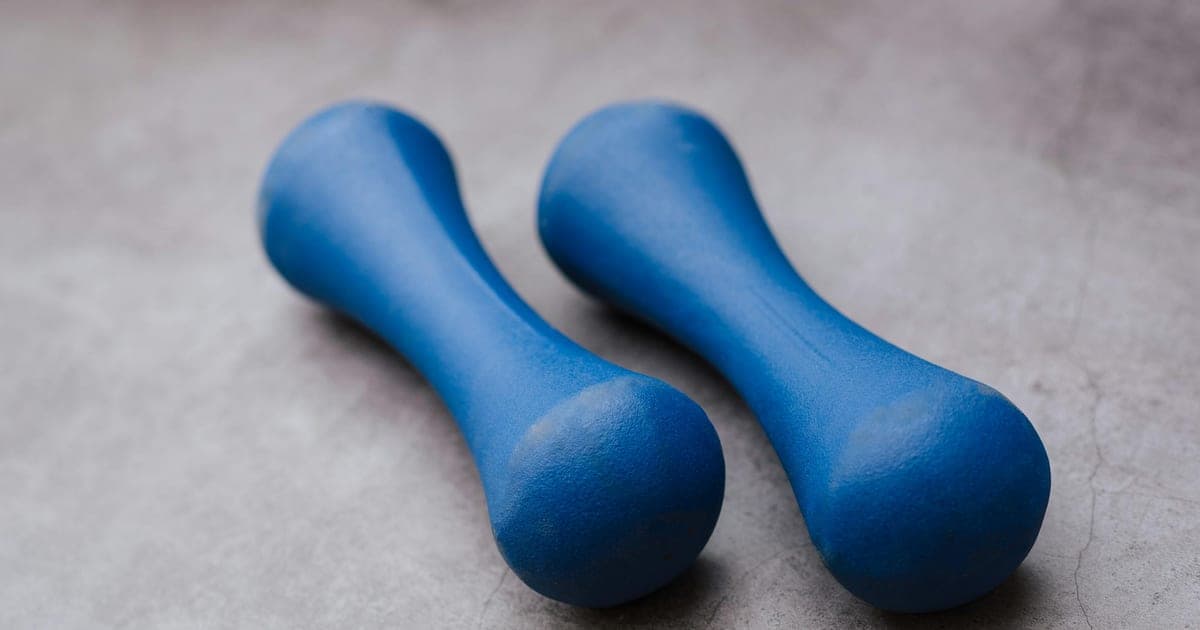
Light dumbbells, resistance bands, heavy barbells. The muscle does not care about the number on the weight. It cares about effort.
The ACSM position stand confirms this directly: hypertrophy occurs across a broad loading spectrum when effort is sufficient. The only advantage of heavy loads is for maximal strength (1RM) development. If your goal is muscle growth and general strength for daily life, you have more options than you think.
Volume Is the Main Driver, Not Frequency or Complexity
The dose-response relationship between training volume and muscle growth is well established. Schoenfeld, Ogborn, and Krieger published a meta-analysis in the Journal of Sports Sciences (2017) showing a graded relationship: more weekly sets per muscle group produce more hypertrophy, with at least 10 weekly sets needed to maximize gains. For a deeper breakdown of how to count your weekly sets properly, see our guide on how many sets per week for muscle growth.
But even low-volume protocols (4 or fewer weekly sets per muscle group) produce substantial results. This is the part people miss. The dose-response curve does not start at zero. Four sets per week still builds muscle. Ten sets per week builds more.
On frequency, a separate meta-analysis by the same team in Sports Medicine (Schoenfeld, Ogborn & Krieger, 2016) found that training each muscle group twice per week produces superior hypertrophy compared to once per week when total volume is equated. Whether three times beats twice is still unclear from the data.
For someone training 3-4 days per week, this means you can distribute your 10+ sets across two sessions per muscle group and cover every base the ACSM recommends.
What This Actually Looks Like for a 4-Day Week
Strip away the academic language and the ACSM guidelines describe something many busy professionals already do, or could start doing tomorrow:
- Train 3-4 days per week
- Hit each muscle group at least twice
- Accumulate 10+ sets per muscle group across the week
- Use whatever equipment you have access to
- Push your sets hard, but stop 2-3 reps short of failure
- Use full range of motion
- Do not overthink your program. Pick compound movements, add a few isolation exercises, and show up consistently.
The position stand found that complex periodization did not consistently impact outcomes for healthy adults. A straightforward plan you follow beats an intricate plan you abandon in week three. And the weekly dose it describes sits close to where the mortality data points too: roughly 90 minutes of strength training per week is where the association with reduced mortality risk concentrates.
This is not permission to be lazy. Effort matters. But effort applied to a simple, repeatable program will beat a complex system that breaks down when your Tuesday meeting runs late or your flight gets delayed.
The Failure Myth Is Dead
Training to absolute muscular failure on every set has been gym gospel for decades. The ACSM position stand puts it to rest. Training close to failure (within 2-3 reps) produces comparable hypertrophy, strength, and power gains with less accumulated fatigue and lower injury risk.
This changes the math for people with demanding jobs. If you do not need to grind out that last impossible rep, your recovery between sessions improves. Your joints feel better. You can train more consistently across weeks and months. And consistency, as the ACSM confirmed, is the single strongest predictor of long-term results.
About Be Fit and Strong Evidence-based fitness coaching for busy professionals in Dubai. Built by Mirza.
Looking for evidence-based coaching that works around your schedule? See how online coaching works.
- 1Currier BS, McLeod JC, Banfield L, et al. (2026). American College of Sports Medicine Position Stand. Resistance Training Prescription for Muscle Function, Hypertrophy, and Physical Performance in Healthy Adults: An Overview of ReviewsMedicine & Science in Sports & Exercise
- 2Schoenfeld BJ, Grgic J, Ogborn D, Krieger JW (2017). Strength and Hypertrophy Adaptations Between Low- vs. High-Load Resistance Training: A Systematic Review and Meta-analysisJournal of Strength and Conditioning Research
- 3Schoenfeld BJ, Ogborn D, Krieger JW (2017). Dose-response relationship between weekly resistance training volume and increases in muscle mass: A systematic review and meta-analysisJournal of Sports Sciences
- 4Schoenfeld BJ, Ogborn D, Krieger JW (2016). Effects of Resistance Training Frequency on Measures of Muscle Hypertrophy: A Systematic Review and Meta-AnalysisSports Medicine